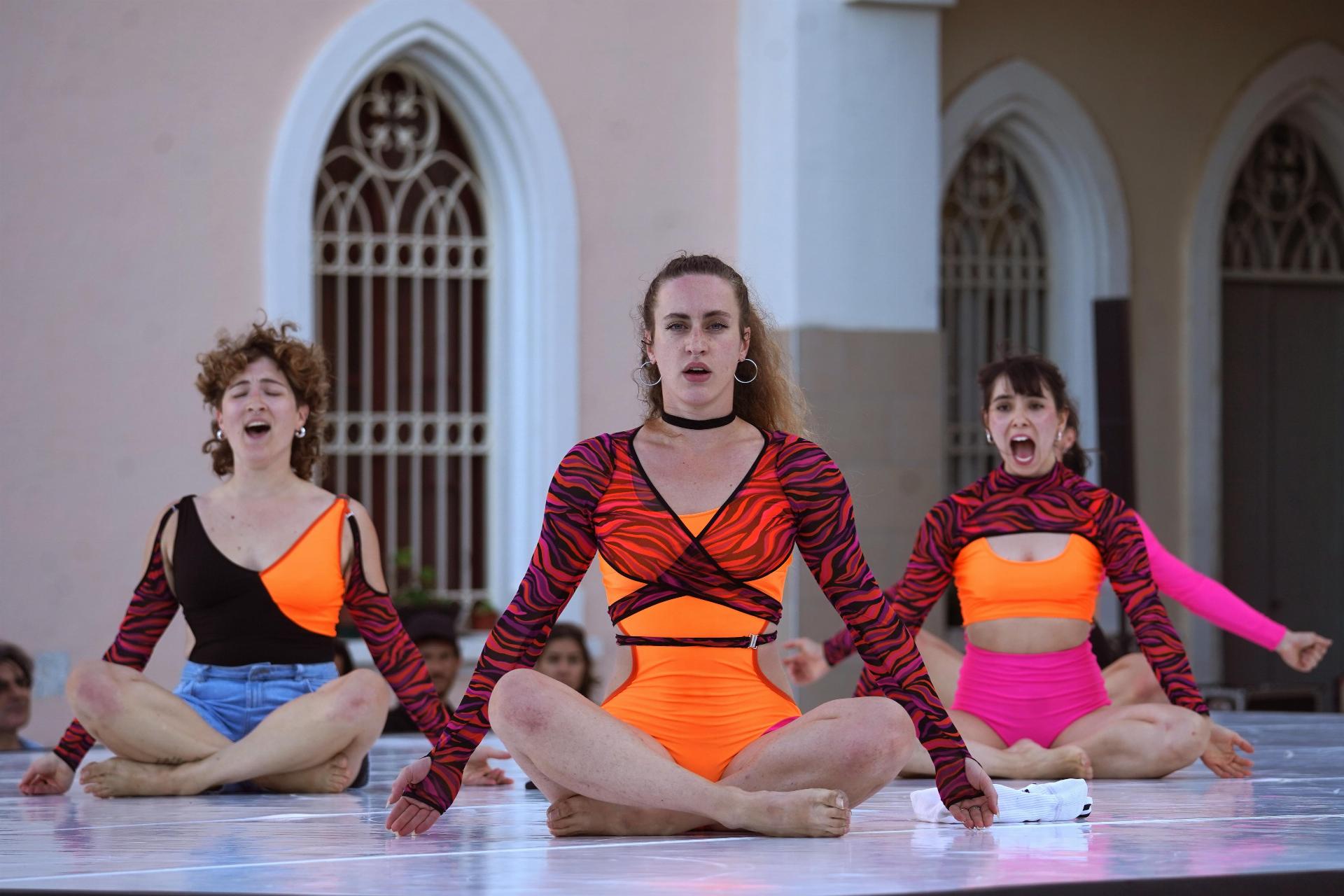
We are happy to present another collaboration with Santarcangelo Festival on an artistic residency which will take place at Reykjavik Dance Festival. This time, we have invited the Italian choreographer Giorgia Lolli who will dive into the Icelandic context and work on her project BODY SWEATS.
Period for the residency: 13-23.02.2026, with a public sharing on Friday February 20 at 6:00 pm at Dansverkstæðið – Hjarðarhagi 47, 107, 107 Reykjavík, followed by a Q&A and a small reception.
Giorgia Lolli on her project BODY SWEATS:
The performance is an homage to Baroness Elsa von Freytag-Loringhoven (1874-1927). The «mother» of Dada was a feminist avantgarde performance artist of the New York modernist circles, known to construct elaborate costumes from found objects creating a «kind of living collage» that erased the boundaries between life and art. My interest in her overlooked and bold writing is motivated by the way she was able to weave subtext in her poetry, especially around topics of female erotics. She was a neurasthenic, kleptomaniac, man-chasing proto-punk, and my archival research examines her legacy and how she set an example for the eccentric divas of the twenty-first century (Courtney Love, Lady Gaga…).
Borrowing the title of the only collection of poems of the Baroness, BODY SWEATS, I wish to indicate a choreography that oozes from bodily materiality. Sweating, hence, becomes a way to examine the entanglement between effort, pleasure and empowerment. The project unpacks our relationship to preconceived systems of rigor, which are especially rich in subtexts when we draw from our backgrounds as movers (especially ballet and fitness). The studio work proposes to go through these familiar movement languages from the positionality of the feminist “I”, to ponder on the possibility of re-writing their meaning.
CONCEPTUAL LANDSCAPE
Researching a feminist-dadaist dramaturgy through movement and text, the work seeks an irreverent precision. Taking place in a 4-sided stage reminiscent of a boxing ring, the choreography works to “explode” the typical frontality of ballet, generating oblique (queer) geometries. Some research questions that inform the creative process are: Can a queer ballet exist? What can dada (the Baroness’ dada) teach us in this direction? Can pleasure be a driving force in creation? (Adrienne maree brown, Pleasure Activism) What is it to make art from bodily materiality and erotic tension towards objects? How do we create and then orient in complex landscapes? (Sara Ahmed, Queer Phenomenology)
The choreographic work is rooted in cultural referentiality: I am looking for an hypertextual body that holds space for references (BODY SWEATS holds echoes of ballet, sports, pleasure, heat, the Macarena)
that is able to incarnate images more than operating from concept.
Costumes and props, exploring a layered visual abundance that interacts with the dancers physicality, support the production of an aesthetic landscape that can unlock these different imagery.
WORKING METHOD
I work with images and consider the studio as a place that welcomes the coexistence of different materials, without establishing intrinsic hierarchies between them. My intent is to make possible the emergence of oblique relationships between materials and bodies. Hypertext for me is a conceptual framework but also a pragmatic compositional tool. It is configured as a relational practice in which digressions — and listening to the intuitions to which they lead — are fundamental for the
choreography to exist as a non-linear and undisciplined entity, capable of bouncing towards other directions, sometimes even incongruous ones. This approach can allow the performance to be considered as a text, accompanied by a series of footnotes.
As Octavia Butler (1998) explains it:
“I generally have four or five books open around the house -I live alone; I can do this -and they are not books on the same subject. They don’t relate to each other in any particular way, and the ideas they present bounce off one another. And I like this effect. I let those ideas bounce off
each other, simmer, reproduce in some odd way, so that I come up with ideas that I might not have come up with if I had simply stuck to one book until I was done with it and then gone and picked up another. So, I guess, in that way, I’m using a kind of PRIMITIVE HYPERTEXT.
***
© Angelo Maggio